

Buying commercial property in New York City can look exciting on paper. A building may be in a busy neighborhood, have tenants in place, and appear to offer dependable rental income. However, those details alone do not tell you whether it is a sound investment.
The real picture becomes clearer when you examine the leases, operating expenses, property taxes, financing, building condition, and legal use. A property with impressive projected returns can become difficult to manage if a major tenant leaves, essential repairs are delayed, or ownership costs are higher than expected.
That is why commercial real estate investing requires more than asking whether a building looks valuable. Buyers need to determine whether its income is reliable, its risks are manageable, and its long-term potential supports the purchase price.
This guide walks NYC buyers through the complete process, from setting an investment strategy and finding suitable properties to reviewing financial records, arranging financing, completing due diligence, and preparing for ownership.
Start With a Clear Commercial Investment Strategy
Direct vs. Indirect Commercial Real Estate Investing
Commercial real estate exposure can be obtained through direct or indirect investment. Direct ownership means purchasing an individual property or an interest in a specific building. It gives the investor more control over tenant selection, financing, improvements and eventual sale. It also requires more capital, professional review and ongoing management.
Indirect investment may involve a real estate investment trust, private fund, partnership or crowdfunding platform. These options can require less involvement, but the investor usually has limited control over individual property decisions. Fees, liquidity, management quality and investment structure must still be evaluated.
This article focuses on buyers who want to buy commercial property in NYC directly. Direct ownership may suit investors who want control over the asset and are prepared to manage the financial and operational responsibilities that follow the purchase.
Build a Clear Investment Buy Box
Before reviewing listings, define the type of opportunity you are prepared to purchase. Investors often call these requirements a buy box. A useful buy box identifies the preferred location, property type, price range, expected return, tenant profile, physical condition and management requirements. It should also reflect how much renovation, vacancy and regulatory complexity the buyer can handle.
For example, one investor may want a fully occupied mixed-use building in Lower Manhattan with limited immediate repairs. Another may prefer a vacant commercial condominium that can be improved and leased. These properties require different amounts of capital, experience and management.
Your strategy should answer several practical questions. Are you seeking dependable income or future appreciation? How long do you plan to hold the property? Will you use financing? Can you absorb an extended vacancy? Are you prepared to improve the building or do you need an asset that already operates smoothly?
A defined buy box prevents the buyer from spending time on properties that do not support the investment plan. Buyers comparing different asset types can also seek guidance from an experienced real estate consultant in Chinatown, NYC.
Choose the Right Commercial Properties Types

The main commercial property categories respond differently to tenant demand and market changes.
Retail properties
Retail assets include stores, restaurants, salons and service businesses. Visibility, frontage, pedestrian activity, nearby businesses and permitted use can affect their performance. The buyer should consider whether the space can serve several types of tenants. A highly specialized restaurant may be expensive to convert, while a flexible storefront may attract a broader range of businesses.
Office properties
Office properties range from small professional suites to large multi-floor buildings. Transportation, natural light, elevators, security, technology, floor layout and building quality influence demand. An older office may have an attractive purchase price but require significant improvements before it can compete for modern tenants.
Industrial and warehouse properties
Industrial property may support storage, distribution, light manufacturing or production. Loading facilities, truck access, ceiling height, floor capacity, power supply, zoning and environmental history are particularly important.
Multifamily properties
Multifamily buildings generate residential rent. NYC buyers must evaluate legal unit count, tenant records, rent-regulation status, housing violations, maintenance history and operating costs.
Mixed-use properties
Mixed-use properties combine commercial and residential spaces. Multiple income sources can provide diversification, but each part of the building needs separate review.
A buyer searching for a mixed-use property for sale in NYC should verify residential rents, commercial lease terms, utility arrangements, legal uses, fire separation and compatibility between tenants. Available commercial properties in Chinatown can provide useful context when comparing local retail, office and mixed-use opportunities.
Find Potential Investment Properties
Public listings are one source of commercial opportunities, but they do not represent the entire market. Buyers may identify properties through commercial listing platforms, brokers, local ownership relationships, attorneys, lenders, property managers and direct outreach.
Every property discovered during the search should be tested against the established buy box. A lower price should not make an unsuitable property attractive, while a prominent address should not replace financial analysis.
When reviewing a commercial property for sale in NYC, gather enough preliminary information to decide whether the property deserves deeper investigation. Useful early documents include the offering memorandum, rent roll, basic operating statement, tenant summary, property-tax information and available building records.
The objective at this stage is not to complete full due diligence. It is to eliminate properties that clearly fail to meet the investor’s location, income, condition or price requirements.
Calculate the Complete Acquisition Budget
The purchase price is not the total amount required to complete a commercial real estate investment. A buyer may also need funds for the down payment, lender fees, legal services, title work, appraisal, engineering inspection, environmental assessment, insurance and recording expenses. After closing, the building may require repairs, renovations, leasing commissions and tenant improvements.
Cash should also be reserved for vacancy and operating expenses. If a tenant leaves soon after the purchase, the owner may need to pay building costs while also funding improvements and marketing the space.
An apparently discounted property may become expensive when deferred work is identified. Roof replacement, façade repairs, elevators, boilers, electrical systems and plumbing can significantly change the acquisition budget.
Before making a final offer, separate the expected costs into three groups:
- Purchase and closing costs
- Immediate renovation and leasing costs
- Ongoing operating and capital reserves
This calculation provides a more accurate view of the capital required to purchase and stabilize the asset.
Verify How the Properties Produces Income

A commercial property may generate base rent, additional rent, expense reimbursements, parking fees, storage income or other permitted charges. The lease determines which amounts are dependable and which may change.
Scheduled rent should be adjusted for vacancy, concessions and collection losses to estimate effective income. Operating expenses must then be deducted to calculate net operating income.
Net Operating Income = Effective Property Income − Operating Expenses
Operating expenses may include property taxes, insurance, utilities paid by the owner, property management, cleaning, security, maintenance and routine repairs. Mortgage payments and the investor’s personal income taxes are generally evaluated separately.
Simplified income analysis
| Financial item | Annual amount |
| Scheduled property income | $300,000 |
| Vacancy and collection allowance | −$18,000 |
| Effective income | $282,000 |
| Operating expenses | −$112,000 |
| Net operating income | $170,000 |
The $170,000 is not necessarily the owner’s final cash flow. Debt payments, major capital work and other ownership expenses can still reduce the amount available to the investor.
When evaluating an income-producing property in NYC, buyers should compare the seller’s figures with signed leases, tenant ledgers, bank deposits, tax bills, utility bills and vendor invoices.
Calculate More Than the Cap Rate
Cap rate is useful, but it cannot answer every investment question.
It is calculated by dividing net operating income by the property’s price or value.
Cap Rate = Net Operating Income ÷ Property Price
If a property produces $170,000 in net operating income and costs $2.5 million, the cap rate is 6.8%.
A higher cap rate may represent more income relative to the price, but it can also indicate a weaker location, unstable tenants, deferred maintenance or greater vacancy risk. A lower rate may reflect stronger tenants, a desirable location or more predictable income.
Investors should also review cash-on-cash return, which compares annual cash flow after debt service with the amount of cash invested. A property can have a reasonable cap rate but weak cash flow if its financing is expensive.
Debt-service coverage ratio, or DSCR, measures whether the building’s income can support its loan payments. Lenders commonly examine this metric when deciding whether the property can carry the proposed debt.
Lease rollover, operating-expense ratio and total projected return should also be considered. Using several measures together creates a clearer picture than relying on cap rate alone.
Stress-Test the Financial Projections
A deal should not work only under ideal assumptions. Create alternative projections showing what happens if vacancy increases, repairs cost more than expected, insurance rises, or a major tenant leaves. The model should also test the effect of higher interest rates when the property is refinanced.
A practical stress test might reduce expected income, increase expenses and add a capital repair. If the property immediately becomes unable to cover its debt and operating costs, the original projections may leave too little room for error.
The investor does not need to predict every future event. The purpose is to determine whether the property can survive common ownership problems without requiring emergency capital.
Treat the Rent Roll as a Risk Report
The rent roll identifies the tenants, occupied spaces, rents and lease dates. It should not be treated as proof that all listed income is being collected. Compare the rent roll with signed leases, payment histories, security deposits and bank records. Verify that tenants occupy the listed spaces and pay the stated amounts.
Pay close attention to lease expiration dates. A fully occupied building may face significant vacancy if several leases end shortly after closing. Tenant concentration is another concern. If one business produces most of the income, the building’s performance depends heavily on that tenant’s ability and willingness to remain.
Each commercial lease should be examined for permitted use, scheduled increases, renewal rights, assignment provisions, termination options, guarantees, maintenance responsibilities and expense reimbursements. A long lease with a dependable tenant may provide stable income. A long below-market lease, however, can limit future growth. A short lease can create an opportunity to reset the rent, but it can also lead to vacancy, renovations and brokerage expenses.
Confirm Zoning and Legal Use
Before purchasing a commercial investment property in NYC, confirm that its current use and proposed future use are legally permitted.
The Certificate of Occupancy may identify approved uses, the legal number of units and permitted occupancy on each floor. Zoning records can indicate whether retail, office, restaurant, residential, industrial or other activities are allowed.
A property may have been altered or converted without proper approval. A basement may be marketed as commercial space even though it is approved only for storage. A restaurant may have incomplete permits. A mixed-use building may contain an additional residential unit that does not appear in official records. These issues can affect financing, insurance, tenant occupancy, improvements and resale.
ZoLa provides preliminary zoning and land-use information. DOB NOW and the Buildings Information System can provide available permits, complaints, violations and occupancy records. A qualified attorney, architect or zoning professional should investigate any inconsistency.
Complete NYC-Specific Due Diligence
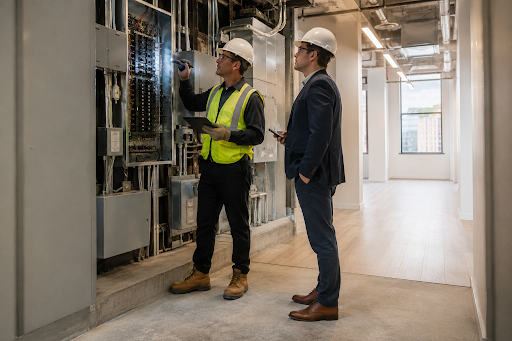
Commercial property due diligence should address the building’s legal, financial, physical and operational condition. Title and ownership records should be examined for recorded mortgages, liens, easements and other restrictions. The buyer should verify property taxes, water charges, open permits, violations, tenant records and existing contracts.
A professional inspection should assess the roof, façade, structure, plumbing, electrical system, elevators, heating, cooling, drainage and fire-safety equipment. The report should distinguish immediate repairs from work that may be required during the planned holding period.
Environmental review may be appropriate when the property has been used for dry cleaning, automotive work, fuel storage, manufacturing or another potentially contaminating activity.
The full NYC investment property due diligence guide explains these records and inspections in greater depth. Due diligence is not intended to prove that the building has no problems. It allows the buyer to understand those problems before deciding whether to proceed, renegotiate or leave the transaction.
Compare Commercial Financing Structures
Commercial lenders evaluate more than the borrower’s credit. They may examine property income, tenant strength, building condition, borrower experience and the proposed business plan.
Loan terms can include the down payment, interest rate, amortization schedule, maturity date, required reserves, personal guarantees, prepayment penalties and balloon payment.
Two loans with similar interest rates can produce different results if one requires faster repayment or has a shorter maturity. The investor should calculate how each financing structure affects annual cash flow and refinancing risk.
Financing discussions should begin early. Waiting until after an offer is accepted can create delays or reveal that the property does not support the planned loan.
Understand the Transaction Process
Once the buyer identifies a suitable property, the transaction may progress through an offer or letter of intent, contract negotiation, due diligence, financing, final documentation and closing.
The offer should reflect the financial analysis rather than the seller’s marketing claims. Important terms may include the price, deposit, due-diligence period, financing conditions, closing schedule and treatment of leases, deposits or unresolved property issues.
A letter of intent may summarize the proposed business terms, but the final contract determines the parties’ legal responsibilities. A New York real estate attorney should review and negotiate the contract.
During due diligence, new information may support the original offer or provide a reason to request repairs, a credit, an escrow arrangement or revised pricing. At closing, the buyer should confirm how leases, tenant deposits, property records, vendor contracts and operating information will be transferred.
Prepare for Management Before Closing
The property must continue operating after the transaction is complete. Commercial property management may include rent collection, tenant communication, lease administration, inspections, maintenance, vendor coordination, insurance documentation, expense tracking and financial reporting.
A buyer should decide who will manage these responsibilities before acquiring the property. The investment budget should include professional management even if the owner initially plans to handle the work personally.
Professional property management services in Chinatown can help owners oversee leases, tenants, maintenance and building performance. Good management can protect income and identify problems early. Weak management can turn a promising acquisition into an underperforming asset.
Plan the Exit Before You Buy
Every investment should have a possible exit strategy. An investor may plan to hold the building for income, improve it and sell, refinance after increasing value, reposition the tenant mix, or redevelop the property where legally and financially practical.
The expected exit affects decisions made at acquisition. A short holding period may not justify major improvements that take years to recover. A long-term owner may prioritize building systems, tenant stability and steady income.
The exit plan does not need to predict an exact future sale. It should explain how the investor expects to realize the value created by the property.
Work With an Experienced NYC Commercial Real Estate Broker

A commercial transaction can require a broker, attorney, lender, title company, accountant, engineer, insurance advisor, environmental consultant, architect and property manager.
Each professional evaluates a different part of the acquisition. The broker assesses market positioning and coordinates negotiations. The attorney reviews legal obligations, while engineers and other specialists evaluate physical and regulatory concerns.
Jonathan Maimran brings more than two decades of experience in New York City real estate brokerage and property management. This combined perspective helps investors examine both the transaction and the operational responsibilities that follow closing.
Buyers ready to find a suitable opportunity can work with an experienced commercial real estate broker in NYC to compare properties, assess local market evidence and coordinate the purchase process.
Final Thoughts
Commercial real estate investing in NYC can create income, portfolio diversification and long-term asset growth. However, the quality of the investment depends on the research completed before the buyer signs a contract.
A commercial building should be evaluated as both physical property and an operating business. Its location and condition matter, but so do its tenants, leases, expenses, financing and management requirements.
Before buying, define a clear strategy, verify the property’s income, review every lease, calculate realistic costs, confirm legal use, inspect the building and stress-test the financial projections. With experience in brokerage, consulting and property management, Jonathan Maimran Real Estate helps buyers evaluate commercial and mixed-use opportunities across Chinatown and Manhattan.
Frequently Asked Questions
How much money is needed to buy commercial property?
The required capital depends on the purchase price, financing and property condition. Buyers must budget for the down payment, closing expenses, due diligence, immediate repairs, tenant improvements and operating reserves.
What financial records should a commercial buyer request?
Buyers should request rent rolls, leases, payment histories, operating statements, tax bills, insurance records, utility expenses, vendor contracts and documentation for major repairs or improvements.
What is a good cap rate for NYC commercial property?
There is no universal target. An appropriate cap rate depends on location, property type, tenant stability, lease structure, physical condition, growth potential and investment risk.
Should buyers purchase vacant or occupied commercial property?
An occupied property may provide immediate income, while a vacant property may offer greater control over improvements and leasing. The better option depends on capital, experience, tenant demand and investment strategy.
Why is property management important after closing?
Management supports rent collection, lease compliance, tenant communication, maintenance, inspections and financial reporting. These responsibilities directly affect occupancy, expenses and long-term asset performance.
Official NYC Property Research Resources
- ACRIS Property Records
- DOB NOW Public Portal
- NYC Buildings Information System
- ZoLa Zoning and Land Use Map
- NYC Property Information Portal
These public resources support initial research but do not replace professional legal, title, zoning, engineering, environmental or financial review.