

Finding the right commercial property for rent in New York involves more than selecting an available office or storefront. A space may appear suitable in photographs but fail to provide the layout, legal use, electrical capacity, customer access, or rental terms that a business needs.
The right property must support both current operations and future plans. Before beginning the search, tenants should establish their space requirements, preferred location, total occupancy budget, and expected rental period. They should also understand how responsibilities for repairs, utilities, insurance, and improvements will be divided.
This guide explains how to compare commercial rental properties in New York, Manhattan, including offices, retail storefronts, small business spaces, and entire commercial buildings. It also covers current market conditions, location selection, property inspections, zoning, costs, and important contract terms.
Understand the New York Commercial Rental Market
New York is not a single commercial real estate market. Office and retail conditions vary considerably among Midtown, Midtown South, Lower Manhattan, Chinatown, SoHo, Tribeca, and other business districts.
Recent statistics show why tenants should review local conditions instead of relying on a citywide assumption. According to Cushman & Wakefield’s Q2 2026 report, Manhattan’s overall office asking rent was $72.83 per square foot, while its reported vacancy rate declined to 19.3%. Another research methodology from Colliers placed the average asking rent at $78.03 per square foot and availability at 13% for the same quarter.
These figures are not contradictory measurements of exactly the same thing. Commercial reports can use different property samples and definitions of vacancy or availability. They should be treated as market indicators rather than the price of a specific property.
Conditions also differ within Lower Manhattan. The Downtown Alliance’s Q1 2026 report placed the district’s overall office asking rent at $56.67 per square foot. Therefore, a New York-wide average cannot replace an analysis of comparable spaces near the property being considered.
Define Your Business Space Requirements
Before viewing listings, identify how the property will be used. This helps eliminate unsuitable spaces and reduces the risk of paying for square footage that the business does not need.
Start by considering:
- The number of employees and customers
- Required private offices or workstations
- Reception and waiting areas
- Storage and equipment requirements
- Kitchen, restroom, and utility needs
- Delivery and loading access
- Customer visibility
- Accessibility requirements
- Future expansion plans
A professional office may prioritize privacy, internet capacity, transportation, and building access. In contrast, a restaurant or retailer may require storefront visibility, ventilation, plumbing, signage, and consistent pedestrian activity.
Businesses looking for a commercial property for rent in Chinatown should create a written list of essential features before comparing available properties.
Choose the Right New York Location
Location should reflect how the business operates rather than how recognizable an address appears. A premium street may not provide value if customers cannot reach it conveniently or if the surrounding businesses do not support the intended use.
Evaluate:
- Subway and bus access
- Pedestrian activity
- Street and storefront visibility
- Vehicle and delivery access
- Nearby businesses
- Building operating hours
- Employee commuting needs
- Evening and weekend activity
- Neighborhood rental levels
- Planned construction or street disruption
Visit the area at different times. A block that appears quiet in the morning may become busy during lunch or evening hours. Likewise, heavy pedestrian traffic does not automatically mean that the people passing the property are relevant customers. Chinatown can support office, retail, food, service, and professional uses, but conditions vary by street, floor, frontage, building, and proximity to transportation.
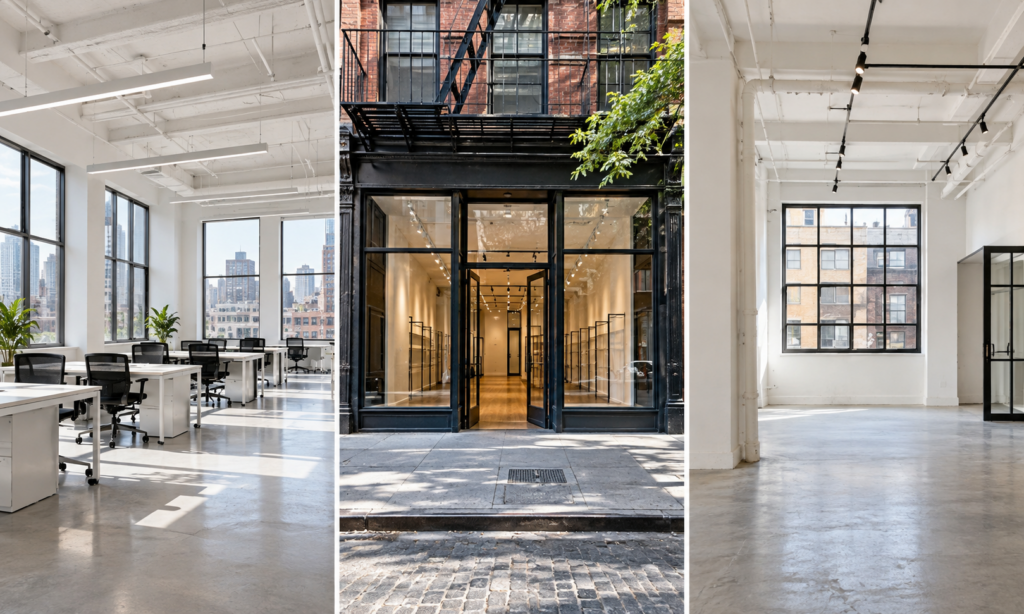
Compare Different Types of Commercial Property for Rent
Different property types create different costs and operational requirements.
| Property type | Often suitable for | Important considerations |
| Office space | Professional, administrative and creative businesses | Layout, internet, elevators and building access |
| Retail storefront | Shops and customer-facing services | Frontage, visibility, signage and foot traffic |
| Restaurant space | Food and beverage businesses | Ventilation, gas, plumbing and permitted use |
| Small commercial space | Startups and independent businesses | Efficient layout, affordability and flexibility |
| Full commercial building | Larger or multi-department operations | Maintenance, security and operating responsibilities |
| Mixed-use property space | Retail, office and service businesses | Residential neighbors, operating hours and building rules |
The previous tenant’s use should not be treated as proof that a new business will automatically be approved. Tenants should independently confirm the permitted use and necessary approvals.
Compare Base Rent With Total Occupancy Cost
The advertised rent is only one part of the cost of occupying a commercial property. Tenants should calculate the complete financial commitment before comparing spaces.
Potential costs include:
- Base rent
- Security deposit
- Rent increases
- Utilities
- Insurance
- Cleaning and waste collection
- Common-area expenses
- Property-related charges
- Repairs and maintenance
- Signage
- Construction and interior improvements
- Professional and permit fees
Commercial rents are often presented as an annual price per square foot. For example, a 1,500-square-foot office quoted at $60 per square foot annually would have a base rental calculation of:
1,500 × $60 = $90,000 per year
That equals $7,500 per month before additional expenses.
However, the rentable square footage may be greater than the area that the tenant can use exclusively. Ask how the quoted area was calculated and whether it includes a proportionate share of common areas.
Understand What Market Statistics Do—and Do Not—Show
Market data can help tenants understand general direction, but it cannot determine whether an individual asking rent is reasonable.
New York retail statistics provide a useful example. CBRE reported an average asking rent of $678 per square foot across the prime retail corridors it tracked in Q2 2026. Cushman & Wakefield reported an average of $710 across its selected corridors.
These figures should not be applied directly to every Chinatown storefront. They represent selected Manhattan retail corridors, and rents can differ dramatically according to street, frontage, size, visibility, condition, and permitted use.
Instead, compare a property with recently marketed spaces of a similar type in the same immediate area. Ask whether the quote represents the asking rent or the amount tenants have recently agreed to pay.
Confirm Zoning and Permitted Use
A visually suitable property may not legally support the intended business activity. Before making a commitment, confirm the property’s zoning, certificate of occupancy, approved use, and any required permits.
New York City’s official ZoLa map provides zoning and land-use information. However, tenants should not depend on the map alone when the proposed operation involves construction, food preparation, assembly, healthcare, manufacturing, or another regulated use.
Relevant questions include:
- Is the intended business permitted?
- Does the certificate of occupancy support the use?
- Are additional approvals required?
- Are there restrictions on signs?
- Are the proposed operating hours allowed?
- Will construction require permits?
- Does the property meet accessibility and safety requirements?
A qualified attorney, architect, expediter, or other appropriate professional should review complex use and compliance questions.
Inspect the Property’s Physical Condition
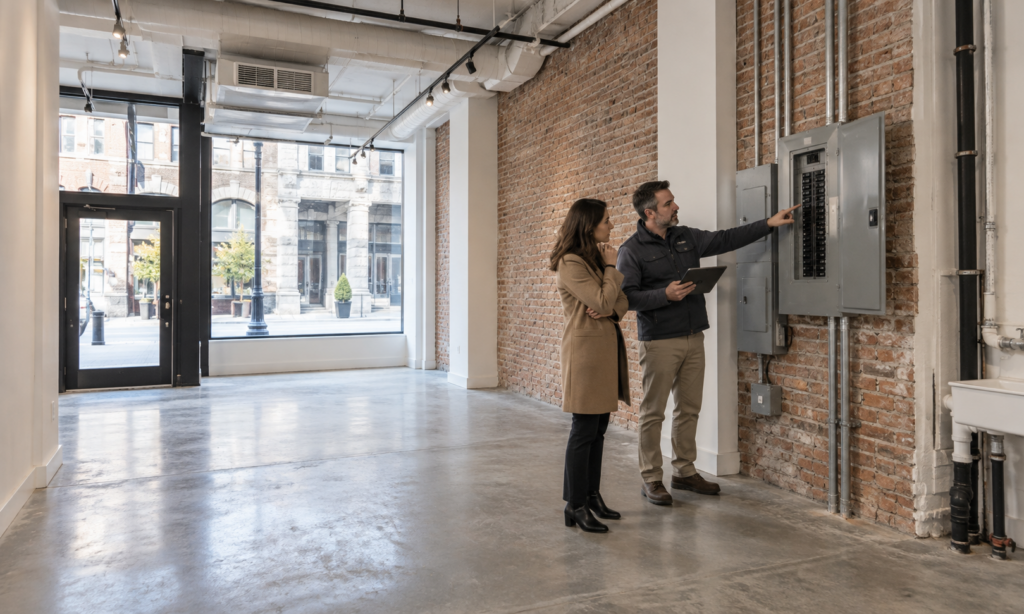
Inspect the property before agreeing to rent it. Existing defects can become expensive if responsibility for improvements and repairs is not clearly established.
Review:
- Heating, cooling, and ventilation
- Electrical capacity
- Plumbing and drainage
- Fire and life-safety systems
- Elevators and stairs
- Restrooms and accessibility
- Windows, ceilings, walls, and floors
- Water damage or visible moisture
- Internet and telecommunications access
- Loading and delivery areas
- Security and building access
If the business requires specialized equipment, confirm that the property can support it. Restaurants, salons, medical offices, workshops, and technology businesses may have electrical, plumbing, ventilation, or structural requirements that an ordinary office does not.
Record the property’s existing condition and identify which improvements will be completed by the owner and which will be the tenant’s responsibility.

Review the Most Important Rental Terms
Although people commonly search for commercial space “for rent,” occupancy is normally governed by a commercial rental agreement or lease. Every term should be reviewed carefully before signing.
Important provisions include:
- Rental period
- Base rent
- Scheduled rent increases
- Security deposit
- Renewal options
- Permitted use
- Repair responsibilities
- Maintenance obligations
- Insurance requirements
- Signage rights
- Assignment and subletting
- Personal guarantees
- Default provisions
- Early termination
- Property delivery condition
Tenants should also determine whether the owner is offering a rent-free preparation period, construction contribution, or other improvement allowance. These concessions may reduce initial costs, but they should not distract from long-term rent increases or unfavorable responsibilities.
A New York commercial real estate attorney should review the final documents and explain the tenant’s legal obligations.
Evaluate Small Commercial Space Carefully
A small commercial space for rent may suit a startup, professional practice, independent retailer, or service business. However, smaller spaces are not automatically more affordable on a per-square-foot basis.
A compact property must still provide usable circulation, storage, equipment clearance, customer access, and required facilities. An inefficient floor plan can make a larger but better-designed space more practical.
Before choosing a small unit, prepare a basic layout showing furniture, workstations, storage, equipment, and customer areas. Confirm whether the business could continue operating if staffing, inventory, or customer demand increases.
Questions to Ask Before Renting Commercial Property
Before selecting a property, ask the owner or representative:
- What expenses are charged in addition to base rent?
- How was the rentable square footage calculated?
- What business uses are permitted?
- Who is responsible for repairs and maintenance?
- Are rent increases scheduled?
- Is a renewal option available?
- What improvements may the tenant make?
- Who pays for construction and permits?
- Are signage rights included?
- What insurance is required?
- Can the space be assigned or sublet?
- What personal guarantee is requested?
- What condition will the property be delivered in?
- Are there restrictions on operating hours or deliveries?
Responses should be reflected accurately in the written agreement rather than left as informal promises.
Work With a Local Commercial Real Estate Broker
Online listings can help tenants identify possibilities, but they may contain incomplete descriptions, outdated availability, or costs that are not immediately clear.
Commercial real estate brokerage services can help a tenant define requirements, identify suitable spaces, arrange property tours, compare local asking rents, and communicate with owners. A broker can also help organize the business terms for review by the tenant’s attorney.
Jonathan Maimran works with businesses, owners, and investors across Chinatown and Manhattan. His local experience can help tenants consider factors beyond square footage, including access, visibility, property condition, business suitability, and long-term occupancy needs.
Property owners who need ongoing operational support can also review Jonathan Maimran’s property management services in Chinatown.
Final Thoughts
Choosing the right commercial property for rent in New York requires a structured comparison of location, layout, total cost, permitted use, condition, and rental terms.
Market statistics provide useful background, but they should not be used as a substitute for property-specific research. A Manhattan office average or prime retail corridor figure does not establish the correct rent for a Chinatown storefront or office.
Define the business requirements first. Then compare suitable properties, inspect their condition, confirm legal use, calculate total occupancy costs, and obtain professional review before signing. This process can help the business avoid unsuitable space and choose a location that supports its operations and future plans.
Frequently Asked Questions
How do I find commercial property for rent in New York?
Define your preferred location, budget, square footage, use, and essential features. Then compare relevant listings, work with a local commercial broker, visit properties, confirm legal use, and calculate total occupancy costs before choosing a space.
How much does commercial property cost to rent in Manhattan?
Costs vary significantly by neighborhood, property type, floor, frontage, condition, permitted use, and building quality. Marketwide reports provide general benchmarks, but tenants should compare similar properties in the same immediate area.
What is included in commercial rent?
The quote may cover only base rent. Utilities, insurance, maintenance, common-area costs, property-related charges, repairs, construction, and other expenses may be additional. Request a written breakdown of all expected charges.
How much commercial space does a small business need?
The answer depends on employees, customers, equipment, storage, circulation, and growth plans. Prepare a basic layout before choosing square footage so the business does not rent an inefficient or unnecessarily large property.
Should I hire an attorney before renting commercial property?
Yes. A qualified New York commercial real estate attorney can review the agreement, explain legal obligations, identify unusual terms, and help ensure that negotiated business points are accurately documented.